Table Of Content
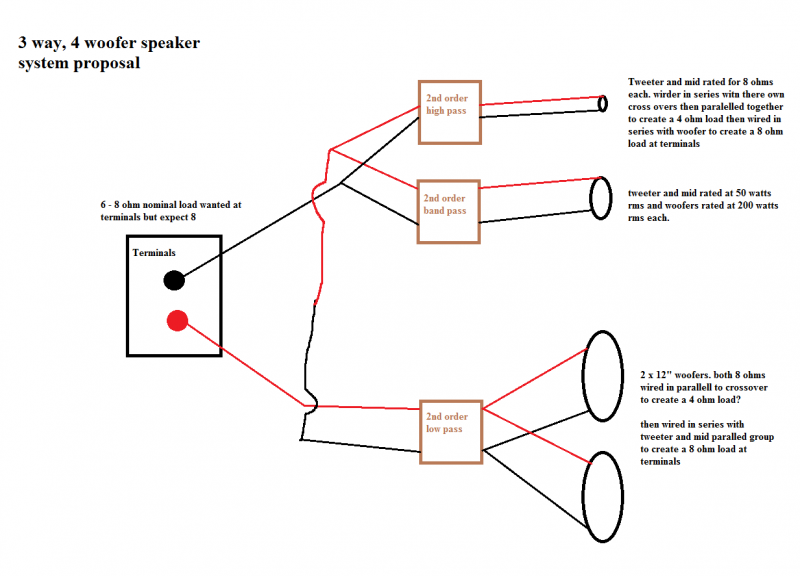
In a 2-way setup, most likely, the woofer only need 1st order filter, so less components. Crossover capacitors and inductors each add a 90° phase difference, giving 2nd order crossovers a 180° out of phase condition that will affect the sound. Another belief is that even order (2, 4, 6...) order crossovers should beavoided. Even order crossovers tend to have spikes or dips in the frequency responsearound the crossover point. These spikes can be as bad as -30db, but can easily besolved by reversing the polarity of only one of the speakers, limiting the spike toabout +- 3db. A 2nd order, maybe even a 1st order crossover can be used with themid/woofer combo, while a minimum 3rd order crossover should be used with the mid/tweeter.
How We Selected The Best Tower Speakers
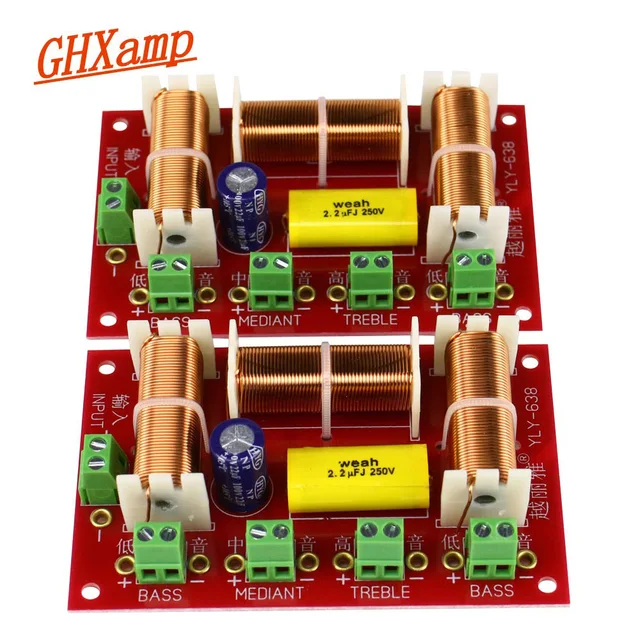
Finally, mount the crossover in your speaker, connect the crossover leads to the back of your binding post,and connect the speakers to the crossover. Negative (-) to Black.When testing your speaker, pay attention to possible Phase Shift problems(See the Crossover Guide)where the sound volume dips significantly at one of the crossover points. If you suspect you have a Phase Shiftproblem, reverse the leads (+/-) on one of the speakers to see if the system gets louder.
DIY Loudspeaker Kits for Speaker Builders
This design overview neglects many designconsiderations a professional designer may consider such as time alignment,distortion and polar response but provides a starting point. Based on low frequencyresponse models for the Peerless XXLS woofer, the desired cabinet volumefor the woofer alone is 2.2 cubic feet tuned to 27Hz. To obtain this target volume, we have to alsoaccount for the volume needed for the RS150-8 midrange, volume of the port andthe space occupied by the physical drivers in the system.
DIY floor standing speakers – dual woofer – beginner friendly
I have built a fewspeakers designed by others and have found all of them to sound far better thananything I had heard in the same price range. Just make sure you go with a project that has been built and reviewed byseveral others. At the end of thisarticle, I will mention a few projects that are well known and well documentedto give you a place to start. Many DIY kits are available, filled with all the electrical components you need to build your own speaker crossover design.
With the greater frequencyoverlap, voices will not seem to jump from one driver to another as quickly as theywould with a steep crossover. There are no differences in output caused bydifferent impedances with the drivers. The tweeter has 2db sensitivity over the mid,and the woofer has 1db sensitivity over the mid. An L-Pad / Driver Attenuation Circuit will be usedto lower the tweeter output by 1db and the woofer output by 2db. Note that 3-way designs have a midrange output with a higher or lower dB level. In this case, the 3-way design has a 2.45 dB gain compared to the tweeter and woofer outputs which is pretty small.
Joel is committed to providing accurate results that are comparable for each loudspeaker tested. Ultimately,designing your own loudspeaker is something you do because you like thecreative side of designing things. Ifyou are after bang for your buck sound, it is much cheaper and less time consumingto use someone else’s well-established and well-documented DIY design withpre-fabricated cabinets. On the other hand, if you’re looking for something simple yet effective with minimal setup, then a passive crossover may be the way to go.

As stated above, a crossover system is usually the combination of two audio pass filters, each with a cutoff frequency and slope. Setting the cutoff frequency and slope of both filters will determine the crossover point. The crossover point between the midrange and the tweeter is a bit more serious, because you can burnout the tweeter. But since this is a 3 way passive crossover design, there should be no problems in setting the crossover point a bit higher. Any piece of wood will work as a mounting board.You can even use the MDF for the speaker itself.
Dayton Audio MK402 Bookshelf Speaker Teases Audiophile for only $70/Pair - Audioholics
Dayton Audio MK402 Bookshelf Speaker Teases Audiophile for only $70/Pair.
Posted: Thu, 15 Feb 2018 08:00:00 GMT [source]
When using 2 or 3-way setups this should ideally be the point at which the other driver or drivers can produce sound as well. The idea is to find a “middle point” that both can produce sound up to that point without a gap, or significantly weaker, range of output. KEF’s LS50 Wireless monitors brought powered speakers to new heights, with fabulous components, an immaculately crafted design, and custom amplification/digital processing for near-perfect performance. This project was designed inSolidWorks but could easily be done in Google SketchUp.
Inductors are usually just a coil of copper wire, sometimes hundredsof feet long. There are also copper foil inductors which are more expensive, butwork somewhat better. For the larger inductors required for the woofer's crossover,an air core inductor might not be feasible. In these cases, use a ferrite core.If you want to try to make your own inductor to save money, check out theInductor Calculator for information on winding your own coils.
This diagram has been simplified, and only the positive (+) lead is shown, butyou get the idea. The reason for going woofer to tweeter is so that the HPF is beforethe LPF for each bandpass speaker. The inductors (coils) in a LPF have resistance.This resistance affects the impedance of the entire circuit.If you put the LPF before the HPF, the amp will not have a stable load to work with.
You’ll need to decide on a frequency range for your speakers, then select components that can handle those frequencies within your desired budget. It requires a high degree of knowledge and understanding of audio engineering principles, as well as the ability to accurately measure components. Speaker crossovers are used in a variety of situations, in which multiple speaker drivers work together to produce a full-range audio signal.




No comments:
Post a Comment